Saturday, February 28, 2009

All about me and career

The support from my parents has been as great influence in my life even since I have graduated from secondary school. My parent have been giving me a lot of support and did not give up on me even though I have not done well for my ‘O’ level result. For the very first in my life I fear a lot of things and realize what I did during my days in secondary school life was terrible. My parent pin a lot of hope on me that I would be able to pass and go on to polytechnic but I have fail them sadly. Neither the less, till today of who I am, from ITE, Polytechnic and even now doing part time undergrad in UniSim. They still supporting and encouraging me not to give up and persevere in the things I do. Although there was a point in time when I told my parent that I would be taking up social work as my profession upon my graduation from polytechnic, they were rather shock and disappointed upon me after going through the studies in electronic engineering for so many year. Asking me that “Am I really serious of going or taking up social services as a profession career?” and a comment by my parent was that “Do you know that what you have studied in ITE and polytechnic can bring in stable job and high income and by going into the social service sector the salaries wise will be very much lower then what you are suppose to get.” As time passes, they are accepting that I am really into the sector of social service work and have been able to prove to them that I am enjoying and showing them that I am really all out into this field of work.
Anther person who have a great influence and changes in my life was my lecturer when I am studying in ITE. As like many other students who will try to skip their community involvement project or if can avoid doing. She has changes me and makes me realize the important of study and also about the community that need people to help and care for the less fortunate not just for the benefit of our own. She introduces me the club which she in charge and it called Community Service Club or CSC for short. I was skeptical at first not only about the kind of project the club does but also the people who run the club and it members. But after a few rounds of involvements, I begin to realize it not that bad after all and the people were friendly and forthcoming. It not only inculcates many values and valuable lesson. It teaches us the important about an individual of who we are and how we can make ourselves useful for the society while doing the community project.
There one particular area where it further enhances me into what I am was the regular weekly service to a particular community organization which is Rotary Family Service Centre. Where by my teacher had established contact with them for us to do regular service to the children in the centre such as giving tuition, play with them and even organize party or outing with these needy groups of children. I continue with the organization as volunteer after I have graduated from ITE for the next 7 to 8 years doing all sort of community work with the centre from children, youth and even elderly programme.
These are some of the values which I uphold and been practicing and these are accountability, concern for others, family ties, friendship, openness, self-reliance (determination in getting the thing I want), willing to work hard, respect for others, practicality, honesty, self-worth and team work. The way I am being brought up were rather family orientated such as being open and frank with each and every member in the family by having two way communication and honesty.
The important of family was that these are the people who know one another strength, weakness and are always there to support. Especially my parents who given me strong support, being there with me, giving valuable advises and people who understand me well.
My goals in life is to be able to give supports, to use my own life experience to help lead people in the right direction of life, treasure family values and imparting my knowledge to the next generation and of cause my own family in the near future. As I would like to leave my legacy behind for my future family generation who will in turn also impart these entire valuable lesson to the next future generation.
As an individual, I am a person who is more outgoing and tend to mingle well with people especially toward very close friend. But I also tend to be loner at time where I need space to think and do thing quietly. I am being seen as a person who treasures a lot of friendship and a person who make friend easily but individually my close friends who really know me were very few.
Especially when I am in groups with my friends be it outing, dining or entertainment. I am more pro-active in being the observer and play along kind of person in the groups. But when I am required to conduct group session in a formal setting, I can be serious with some laughter in between and also being seen as a person who know the subject well in a particular presentation.
When come to my attitude towards authority, I will display respect for people who are of higher position, fearful of myself if I ever make mistake, being honest and humble at the same time will keep me well balance. But when come to management of conflicts, I am sometime good sometime bad, at loss most of the time and needed sometime to readjust and bounce back onto the right track, tend not to bother too much in conflict that is unable to resolve and let it die of by itself.
Area which I need to improve on is management skill such as conflict, time and priority management, which till today I am still struggling on. Tend to unable to complete all my case note reports on time and at time when there conflict I tend to avoid first instead of handling directly on the spot.
A lot of these values which I mention earlier in the paragraph help me a lot when I see client in my work place. It hold my ground whenever I need to made a certain firm decision together with client for them to help themselves and not depend on other dependently. Most of the client who have seen me are very comfortable, are willing to explore with me further and will always share their problem and happiness about their live and families.
There was once whereby I see myself that I am being too involved into a family situation and I was unable to see the bigger picture of it. I feel for the client not getting any respect from their family member who treat this client very badly and being biased against her. It makes me realize that my own values and experience have got parallel on stronger on this case because of the issues of respecting and being open with each other in the family. I have got a strong sense of view on family ties and hence I tend to move closer in making sure that these values are being instilled. But being practical, majority of the family in general were not being brought up the way my parent had brought me up. Hencefore, in order for me to overcome this I have to be stand by the side and explore other family members in the household and help assist client to find it own strength perspective and empower them to make their own decision within their own family.
Biasness toward certain groups or holding some stereotypes were not an issues to me as I will also get to learn and understand their different culture and their way of life in handling certain issues in life.


Saturday, May 10, 2008

Whispering Hearts Family Service Centre (Club Fidentia)

In vein with achieving the objectives, the program engages a two-pronged approach.


First of which is the creation of Peer Circle. Peer Circle is a Study Partner Program that deals with youths who are in need of academic and emotional support. In a conducive environment, youths are given the opportunity to learn from an adult mentor within a group. The adult mentor would not only coach them in their academic work but also an avenue for them to be in engage in other relevant issues/interests beyond the syllabus. Lessons (such as movie reviews, creative writing or presentation skills workshops) would be transmitted through engaging mediums. It is essential that the Study Partner Program covers beyond tutoring of academic work. Ideally, it should differentiate as an environment where youth are also exposed to new information/ knowledge which could inspire and/or be of use for their future.

The other distinctive arm of Peer Circle is formal on-site mentoring by trained mentors. According to the leading mentoring agency, Big Brother Big Sisters Australia, mentoring is crucial because it ‘aims to provide a structured and trusting relationship that brings young people together with caring individuals who offer guidance, support and encouragement aimed at developing the competence and character of the mentee.’ More often than not, adolescence is often is in a period of loosening home ties, trying new roles and learning to be independent. In this transition, it would be valuable if there is the presence of trusted adults to whom the youth can relate to for guidance. This is especially valuable for low-income youths- having an older brother or sister who cares could act as positive inspiration.

The trained mentors are volunteers from Nanyang Technological University, junior colleges and working adults. The volunteers will attend at least 2 trainings on session/ class management- (1)working with youth and (2)proper mentoring structure.

The second of the two is Youth Inc. Youth Inc is a component that focuses intensively on equipping youths with life skills through Socio-emotional Learning. Life skills comprise the majority of competencies within the personal and social assets; and these competencies require opportunities for learning. Besides imparting life skills, it is conduit for youth to be able to given the opportunities to practice as well as to pay back with meaningful contribution to their families, schools, peer groups and communities (through community service such as service learning projects). It is essential that community service be properly conducted at early level of schooling and continues throughout the years so as to create a climate for community service for a lifetime (Elias, 2003).

Under the umbrella of Youth Inc., a Youth Committee would be established. Youth would be given a fair amount of autonomy to ‘run’ the Club Fidentia. This is to instill in them a sense of ownership and to give them the freedom to plan and organize in a safe environment- to develop and practice life skills taught. Consequently, this is also done with the hope it could increase their self-image and self-worth. At the end of the program, it is aimed that youths would be given the prospect to learn, apply and contribute skills acquired in their lifetime.

In essence, with the two-pronged approach in hand, we hope to empower our youth in becoming responsible and contributing citizens- who are given the opportunities to develop their character to the fullest potential.

Delivery process

Seminar/discussion format as well as experiential learning through indoor/outdoor activities.

Programme structure

Theoretical Underpinnings/ Research

The Ecological model holds the view that the person is embedded within an intricate system of relations. The systems theory shifts attention from the cause-and-effect relationship of the person and the environment to the person as an interrelated whole (Compton & Galway 1999). The notion of transactional causality is emphasized; every part of a system is affected by every other part. The intricate relationship among systems implies that a person’s life event would be affected by environment demands, internal demands, environment supports as well as individual’s coping or adaptive abilities. A problem arises when ‘there is no good fit between the individual’s coping abilities and the demands of the environment or between the desires and the support of the environment.’ As suggested by Germain & Gitterman (cited by Compton & Galaway 1999), individuals fail in their life transitions because of their maladaptive interpersonal processes relating to individual’s coping ability or/and the excessive demands or inadequate support from the environment. Hence, to prevent youths from failing in the various aspects of life, Club Fidentia’s programs aim to increase youth’s environmental support as well as to enhance each of their coping abilities.

With social capital weakening in urban societies, youths who lack significant adults in their lives are especially vulnerable to delinquency and marginalization. Youth mentoring is an effective solution for developing resilience in youth population and its efficacy has been well-documented. According to a study by Big Brother Big Sister, Mentoring: A Synthesis of P/PV’s Research: 1988-1985 showed that mentoring had positive impact on youth. The results shown that young person with a mentor were 46 percent less likely than control group to initiate drug use, 27 percent of them less likely to initiate alcohol use, one-third less likely to hit someone and skipped half as many days of school as control youth. In addition, they feel more competent about their ability to do well in school and reported having positive relationships with their parents and friends (Big Brothers Big Sisters, 2007). Social learning theory posits that individual learn as a result of involvement with others, hence providing a successful adult mentor provide an opportunity for youth to model successful collegiate behaviours and also serve as a valuable opportunity to observe successful other young persons. This is especially useful for adolescence who are at a stage where they venture out of their homes for independence.

Peer Circle is constructed in the hope that youths would be able to garner positive environmental support from adult mentors and professional staffs as well as the positive friendships formed in the program. Program staffs had a role of providing support in the form of screening, orientation and training, and support and supervision to ensure the quality of mentoring provided. This is done with the objective of strengthening their environmental support.

One the other side, Youth Inc. focuses strongly on imparting youths with life skills- to enhance youths’ coping abilities. Socio-emotional learning is a way of teaching and organizing that help children to learn a set of skills to help manage life tasks such as learning, forming relationships and communicating effectively. A study by Curtin University, Academic and socio-emotional learning by Maurice J. Elias states that socio-emotional learning is ‘a missing piece’. It represents a part of education that links academic knowledge with specific set of skills important for success. There is a danger that children grow up with knowledge but without socio-emotional skills and a strong moral compass (Elias, 2003). Hence, the program wants to provide support and opportunities for youths to develop these personal and social assets; in order that they can marry both academic knowledge and skills to have a productive and satisfying life.

Strengths perspective suggests that empowerment is significant in encouraging youth to discover their strengths and enhance their self-determination and autonomy (Herriger, 2002). Through social-emotional learning, youths would have the ability to organize, direct their own lives and to provide resources for their self-determination and independence. As a team, we want to nurture a vision that focuses on resiliencies rather the deficits. Hence we intend to provide leadership opportunities for our youths, giving them prospects of taking charge- in hope that their participation would boost their self-esteem and self-image. Low-income youths often need encouragement from the community that they too are worthy and had the ability to be like any other average youth.

Specific problems that the programme addresses

Our underlying belief that form the basic of this program is the belief that each youth in a unique individual with many various strengths- both known or not yet known to the individual. For this reason it is our goal that youth who enters our program would leave discovering more about their strengths and carry with them the belief that they are a capable and distinctive young person; despite their environmental circumstances. One of the major tasks of this program is to allow the youth to see beyond their individual selves. Our work with youths made us realize that most of them lack the global perspective and a vision beyond the community they lived in. Youths are often too consumed with their self and plights, hence not able to discover that they are resourceful people who have the ability to contribute to others. Also, most of them lack life skills training or an environment for skills to be practiced. In addition, most of the youths lived in low-income families whose parents are relatively less able to guide them in their academic studies and offer them career guidance, hence Peer Circle serve to complement by providing academic and inspirational support. Lastly, there is lack of facilities in the community that our youths can tap on to develop their interests and develop positive friendships. Hence, we want to make available a safe outlet for them to mingle and develop positive bonds while strengthening their selves.

Evidence of Community Need for the Programme/ Rationale for Switching Primary PDPs

Reasons for modification of the programme

Club Fidentia was set up in 2006. After a year’s operation, the program staffs evaluated the program and realized that there are some mismatches and gaps between the needs of the clientele and the services delivered. Our initial hypothesis of our target clientele is students who either have difficulty staying in school or for youths who had dropped out of school, hence we propose an entrepreneurial enrichment component- to harness their talent and to learn new skills for future survival. However the demography of our members varied a fair bit from our initial hypothesis, majority of our members are youth in school and had a higher possibility of staying in school throughout the secondary years. Hence we decided to replace entrepreneurial enrichment component with social-emotional learning which is relatively more relevant for school-going youths.

Also, we also added a new component to complement the study partner program- on-site mentoring. In our first year of operations, there was informing mentoring happening between volunteers and youths. Most of our youths are attached and had strong bonds forged with the volunteers. For accountability, it is essential to formalize our mentoring because it is crucial to monitor and supervise, to ensure the quality of mentoring offered to the youths as well as for safety reasons.

There is no disruption for currents members of Club Fidentia. They would move on to the new programs as the target audience still remains the same. As mentioned above, this program is altered to better meet the needs of our current clientele.

Outcome of environmental scan

In the boundary that we served, the only youth organisations available besides Club Fidentia is Nanyang CC youth group, Boon Lay CC Youth Group and Jurong Town CC youth group. Although there are existing youth groups present, they are more generic as compared to our program. They focused more on activity-based activities and their age requirements ranges from 13-35 years of old. Hence, Club Fidentia differentiates because we focuses specifically on a target group of low-income youth age 13-18. Nevertheless, we could collaborate with them by tapping on their resources for various activities.

Needs Assessment

It is essential for a service provider to deliver services that meet the demands of the service users. It is hence crucial that a needs assessment precedes the development of programs. With the data collected, program staffs are then better able to gauge whether the program proposed is feasible. A needs assessment (refer to appendix B) was conducted in August to September 2007 to examine the needs of the youth being served in conjunction with the program goals and objectives.

We administered a survey to 315 youths within our boundary. Our target group are both clients from our centre’s program- Club Fidentia and Bright Owl Project as well as students from neighbouring primary and secondary schools. Primary six students are roped in because they are potential candidates to be enlisted to our program next year (when they promote to secondary one). 91.4% of all of youth reported that life skills are essential. 67.7% of youth claimed that they have not attended life skills courses before. Out of the 67.7% of youth, 71.48% of them expressed interests in attending life skills courses. Of the choices given, the highest percentages chosen for the component of life skills are conflict resolution skills, leadership skills, stress management skills, social skills as well as problem solving skills. The studies above showed that that there is an emerging need by youths for life skills courses.

In relation to adult mentoring, 78.1% of youths and 68.57% of youths claimed that they did not have an older adult they can looked up to in regards to academic/career aspiration as well as relationship problems respectively. On the other hand, only 28.25% and 19.37% of the youths claimed that they did not have an older adult in regards to personal issues and school work. Hence, it is impetus that our group mentoring be focused on providing academic/aspiration and relationship support. In addition, the youths reported that they face difficulties in communication, goal setting as well as academic work in their lives.

Lastly, the survey questions address the issue of community service. Most of the youths (76.51%) claimed that they participate in community service because of self-satisfaction purposes. This is a very encouraging trend, and should be tapped on so that the spirit of community service would last for their lifetime. More than 80% of the youths had indicated that they are ‘somewhat-interested’ to ‘very interested’ in participating in community service projects. Of all, only 1.27% of the youths had joined an overseas community project, of those who did not, 83.81% expressed high interest in participating in an overseas community project. Participating in community services projects especially overseas projects could have a strong impact of youth. Service experiences usually help youth to encounter other people, ideas and circumstances in ways that broaden their sense of perspective and build empathic understanding and caring connection to the world around them (Elias, 2003).

Consultation with community partners

Club Fidentia work closely with schools within the boundary. As schools focus more on academic support, there are less able to provide social-emotional learning courses. Hence, schools would collaborate with us by referring their students for our programs and provide us with feedback on the needs of the students.

Saturday, July 01, 2006

Making a Difference in The Lives of Students.


WHFSC’s School Social Work Programmes: Making a Difference in The Lives of Students.

Holiday Fiesta @ Xingnan Primary School
BY :Lee Guoxing(Organising Chairman)

The Holiday Fiesta was held from 7th to 9th Jun 2006 at Xingnan Primary School. It was a tripartite effort put in by the school social worker from Whispering Hearts Family Service Centre together with 64 volunteers from The Rotaract Club of Marina City and the Interact Club of National Junior College. A hundred and forty-four students participated in this 3-day experiential, educational and fun-filled camp.
The objectives were three folds. Firstly, to engage students in constructive activities during their holidays. Secondly, to allow students from different classes to come together to forge a greater network of friendships in school. Thirdly, to outreach to students and their parents living within the community, to raise their awareness of the Family Service Centre so that they can approach for help and assistance in family matters.
The students were engaged in all kinds of team-building activities that surfaced their leadership qualities and creativity. They visited a fish farm and learned about nature and its ecological systems. On the last day, students and volunteers put together a grand performance for parents and teachers to mark the finale of the holiday fiesta.
Students, volunteers and workers went home with tired bodies, enriched minds, enlivened spirits and the awareness that a part of their lives have been touched and changed by each other over the last three days.


You can view the picture of the event over at the link below.
Holiday Children Fiesta Day 1

Holiday Children Fiesta Day 2

Holiday Children Fiesta Day 3

Thursday, May 25, 2006

For the month of April and May 2006

Wow, It been really somewhile since i last wrote in here back three mth ago.
OK Here the update,
Had quite a few wonder ups n downs in life for the pass few mth.
Such as attending shirley 21st bday celebration at east coast park. Finally had a chance to see her bf. keke.


Well bside attending friends bday celebration and catching up with old friend from poly. I am also keepin my self occupite with studies and event scuh as now i am trying to finish off my final year project reports.
On top of tat running my club event which i am goin to hold a 3 days kids fiesta as this is my third times attending and running the events with my volunteers from NJC and club members and also some very gd buddies from my secondary sch and poly mates who have attended this event b4.
Now everything is running quite smoothly with the coming up volunteer training which me and the center goin to conduct for all the volunteers on how to handle with kids and wat the objective of service learning.
Bside running and junggling with sch and club events, my RAC MC is going to have a upcoming event which is the installation for the new coming yr of 06/07. What is all this about some of you may be wondering, this is a event whrby the old Board for hte yr 05/06 has come to an end and will be handing over to the next batch of leaders to carry on the lineage to brong RAC MC up to a higher lvl. As for me will be from a community service director of yr 05/06 will be taking over the position of Vice-President for the new yr 06/07.
Haha some of you maybe wondering how come Guoxing is so enthu n passionate abt his club n why is he nt made as a president. haha
To me, President is a person who is making most of the deicision and presiding a meeting and also to guide the members n BODs to bring gd image to the club and keepin the club healthy. As for y am i in this position as vice, it for you to guess and for me to know the outcome of ur answer. haha. But in short to say, weather who is the president of the club it not really a matter as it stil voice down to the person itself as in is he/she enthu and passionate about being a rotaractor and want to help the community at large.
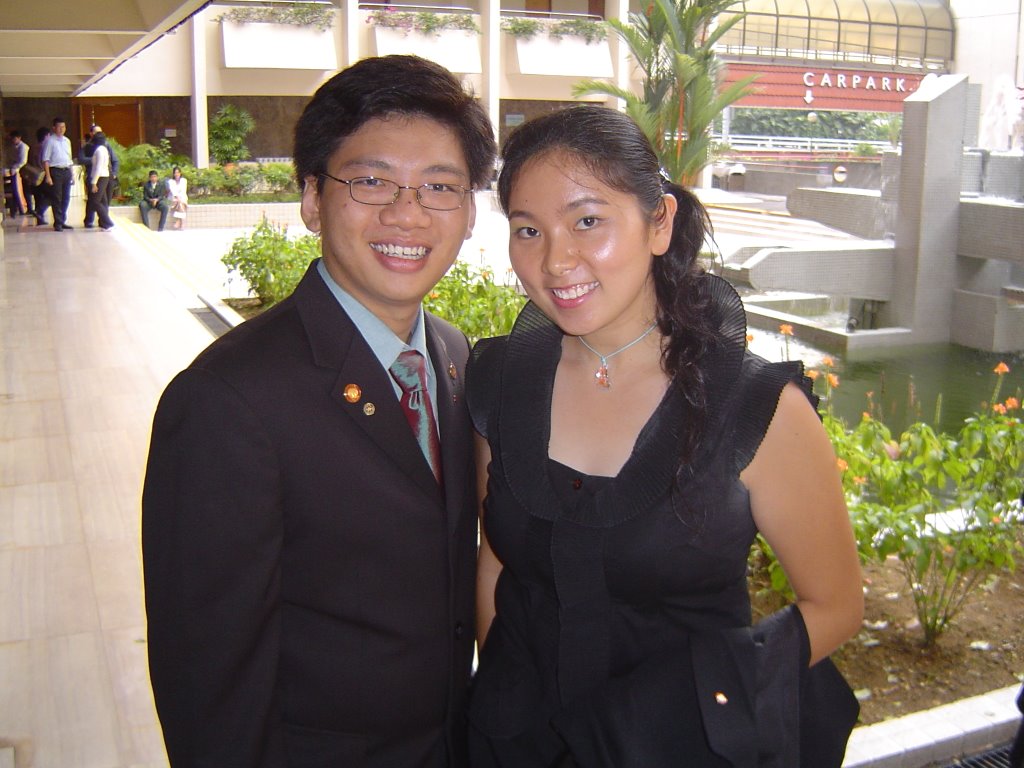
Below is a picture of me and the next president.


Below is another Photo with the new board of directors for the coming yr of 06/07
with absent of apologies who was unable to turn up is our dear lilian who is our incoming international director and also the district scretary of yr 06/07


Friday, April 07, 2006

Hiaz...Life is so meaningless.......

Well, it already the month of April.. wow time really fly real fast. But to me is like time is passing very slow..
How i wish School start next week. But will need to wait for another week b4 sch start..Arghhh..Been so boring at hm. Lazing at home n doing final year prooject and also club proj planning. At least while in sch, I am still be able to chat with my classmate while doing thing or perhap while doing fyp i can switch on my radar to scan and ogle at pretty girls in sch.
Can't wait to do all this again haha, but well i can only be able to do that in sch for the last time. Why, because this is my final semester in Singapore Poly.
Ok enuff of my lame remark above.

Just an update of What i been doing during the pass one mth since holiday both in sch and my club.

As for sch; been doing fyp almost everyday non stop. with a few hr of brk in between while doing. During every brk time i'll spent abt 2hr to see a chinese serial show which i am currently chasing. This serial movie is my cousin borrowed me, it all abt 7 guys and 7 sword that came down to save a particular clan and also preventing the evil from doing bad / harm to the clan n love story. As for now my fyp is i can say we are really on the way to completing it as it a lready more or less about 3/4 of the job.
Oh yesh been also helping out with sch of eee in the preparation of the FOP which gointo start on the 10th April till 13th April. This is my 2nd time involvement in this kinda event whrby we'll meet up all the freshy then try to bond them together so as to prepare them on what is poly life goin to be while they are goin to enbark thier 3yr of studies in poly. For me the main job scope is to get the current yr 1 who going on to yr 2 to supervise them on how to carry out the action plan and to look out for potetial leadership among the freshy and recomment to their new classes and appointing them to be the class representative. As they them self were also a classrep. Alot of student ie the new student have the kind of impression that being a classrep he/she will have a lot of duties or burden to carry on their shoulder. That is the wrong concept as in poly the classrep won;t have any burden at all, jus to basically carry out simple duties even a primary sch kids can do it also. he/she wun be ask to help lecturer carry heavy stuff or collect workbk all this is redundence as you are now a poly student and no longer a secondary or ite student. In poly we treat everyone like a young adult. Of cus being a classrep, at the every end of the semester the classrep will be awarded 4 caa point. some even classrep even get 4 cca by jus doing nutting. and on top of that classrep get the top priority to go to oversea country whras other student dun even get the chance to go. Jus like for my self, for the pass three yr as a classrep, hehe, i been on to cruise, thailand n batam trip to further enhance the leadership skill of all classrep. So Isn;t it good to be a classrep. As you all can see in my blog the video clip of the lastest trip to batam.

On top of jus doing FYP and FOP, I am also planning a proj organinse by Rotaract club of marina city which will take place in this coming june. It quite a big proj that i am embarking on, but my organinsing team and me have some experience in it as this is our 3rd time doing this kinda event and of cus getting the help from National Junior College and some very good friend of my who is willing to sacrifice their time to come join in this meaningful proj. As for now the progress it still going well smoothly with the total number of volunteers is abt more then 60 excluding the organising comm. As for my vision for this proj, my partner n me who is going to embark on the next new rotarct yr 06/07, we going to take this proj to bring it up to the district level for rotaract district 3310 in singapore to go for the district award under community service. But then again it still just a award to be recognise, the main purpose of this proj is to foster the relationship between members and making new networking of friend from other area and to learn from each other and benifit ourself thru this proj with the mind set of wanting to help the community at large with our open mind and our compassionate heart to the community at large. Had attended a Youth-in-action seminar orgainise by the Rotary district for all rotaractors and interactors. More detail of the event can refer to Rotaract Club of Marina City which has the link at the bottom of the page on the left hand colunm bar.

Yup think will write up till here.

Saturday, March 11, 2006

What am i goin to do with this 6 week of holiday

Arghh.....time passes really fast. Just in a moment, it already march the 11th already. Haiz, sometime i really wonder why am i such a dissapoint at time and why that this got to happen to me and why and why and why. If not i should be really enjoying this big hoiliday ahead of me with my fully graduate diploma from the polytechnic and start looking for a career to get on with life, but well i will need to stay back in the polytechnic for another half a sem. Perhap this is buddha wanting to test on me the patient in me or want to tell me that thing that i want i have to earn it thru the hard way.
But anyway, as i jus mention above, time passes very fast and i gt to start planning what i want to do. First priority is to get myself a career to support my family and what kinda job am i goin to take upon..really got to start thinking abt it now. I ve a lot of vision of what i want to do. But will have to take a step at a time.
As for now, since i'm on a temporary on hoiliday brk for 6 week, what am i goin to do. Hiaz as usual friends been tellin me, guoxing arg guoxing why everytime i am so busy, like got to book me b4 hand if nt i gt no time for him/her.
Well this is what i say to them, it all depend, as for now i am rushing my FYP to try to complete 4book out within 6weeks which i set a target for myself n my partner and in hope to complete everything by next sem b4 the mid semester exam and on top of that i am organising and co-organinsing with my own rotaract club n whispering heart family service center for a kids fiesta 2006 in june. In order to get everything out and nicely plan for the 3 fulldays events, planning is the crucial moment n get thing done up got to start this mth. Roughly abt 3mth or more to get thing done like bookin of places of instrest, games, concert, incalculate the kids with all the values to them, gettin 40 -60 volunteers to get them train n participate in the 3days and oso incalculate the young volunteer with objective n value they need to learn, lucky for me as i ve been thru this shit b4 n ve gain lot of expereince with some repeated custosmer volunteer to this proj. So friend out there no worry that i dun ve time for u guys, jus give me a call or drop me a sms i'll reply to u guy and if time permit i'll make a point to meet up.
so in short my hoilday is being cover up by this two big proj on hand and u guys must be wondering especially my own gd buddies from secondary has been saying me do you think by doin all this kinda of social work will get you far and why am i still doin it though i noe that i won't get far even if i really intend to go into this area and the pay is nt high. seriously, i have also thought abt this for a long time, but why am i still goin it. it very hard for me to say. Perhap it the passion or my heart simply tell me jus go ahead with my insterest. Even my own FYP supervisor also told me that i am nt out into the engineering but esle whr. maybe that the reason he gave me the proj which is actually not releated to what i study n it was some sort of how to be a better person n how do we manage of life and to mix ourself with diff cultral background be it in working area or personal life. What i jus say above i maybe wrong, but this is how i feel. Perhap this is due to one person whom i ve alway admire since my days in ITE. She the one who been telling me to go with my heart and give it to my best and what ever setback I have in the pass is over now it the time to take chrg n go ahead with what my heart and feelin in me. My friend n me jus went to vist her during the chinese new yr period and we were really shock n a little upset. Due to her illness back few year ago and after her operation n camotheotapy she has gone dwn alot. but natheless she still as supportive to me n alway ard to give me her advise n listening ear to hear wat i ve to complain n tellin me lot of thing.


okok, think i wrote too much, and if i continue to write, think it goin to take days to complete my story. will continue anither day.

Wednesday, January 25, 2006

ARghhhh

Well this week kinda busy but still able to slack here and there once in a while.
Monday as usual go sch EMI tutorial and i was abt 10 to 15min late as usual and was kinda surprise by my classmate as they say i just came in on time.!!! What was tat suppose to mean? Then i realise it was my lecturer wanna pass me 4 set of lecture note and want me to print for the class. Chay.!! BO bian who call i am the class rep for this technical elective module.
End of tutorial went on for the next lesson which is IC Testing Lab. As usual continue with our PBIL Proj. Dunno i am sway or wat, everytime i go for this lab n complete my prog for this particular IC Chip. Some how or rather the prog always cun work, even after i call upon my lecture to chk whr i go wrong. He will always to me with a frown on his face indicating to him that why it always got to be me who will tend to have this weirld problem even after his chk, whras teh rest of my classmate had got no problem with their prog. Arghhh..but then some how it came to a surprise to me everytime after i play with the delay progation to the clk of the IC. Haha. Just by doin all this IC testing n trouble shooting the time is up and we need to go for our last class. Then i realise that next monday gt no class as it is CNY and we need t hand in the week after then we were told to come back for free access to complete watever that was left n hand in a final report. Arghh..so many report to do!!!!! Then the next class which is OM..Arghh...this is another boring lecture of all module i have..but it quite insteresting thou. LOt of defination to be rem...i always tend to slp in his lecture hall for an hr.
OK
shall continue ltr....buy dinner....Chaozzzz

Sunday, January 22, 2006

Went to buy cny clothes

Today finally went out to get my new cny clothing. Went to suntac city to shop and shopping for clothing i finally stop at one shop and brough two pant n two shirt all from the same shop. Cause I can currently only afford these at the moment as still studying not enuff enuff money to buy branded.
Shop from 2 plus till abt 6plus then came hm for dinner.. Haha must be wondering am i shopping along or with someone or with friend?
Hahaa I shall let you guys go pondor over it.

Wednesday, January 18, 2006

Just a little bored

Hmm, this week a little relex as there no classes for all the 3rd year student in sch of eee as this week is also the week of all the poly open hse. Except for Republic poly which had their open hse in the new campus in woodland had already ended on Tuesday. Everyone who is in the engineering course in SP will be displaying their Final year proj to the public. Not all proj. will be display in the Spnovex as proj that had went thru several rdns selection before these proj is being selected will be highlighted in the open hse. I would like to congratulate those friends of which proj is being highlighted.
As for those whose proj not highlighted, dun be dispair. Take this as a week of hoilday to brk ourselve from sch work or take this time to work on our miniproj which is accounted for in our modules and continue to improve on our FYP..

Monday, January 16, 2006

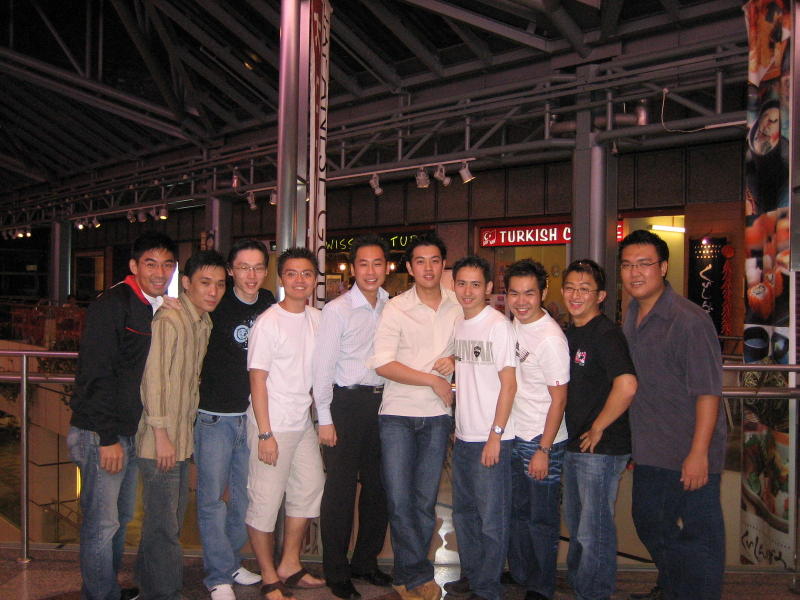
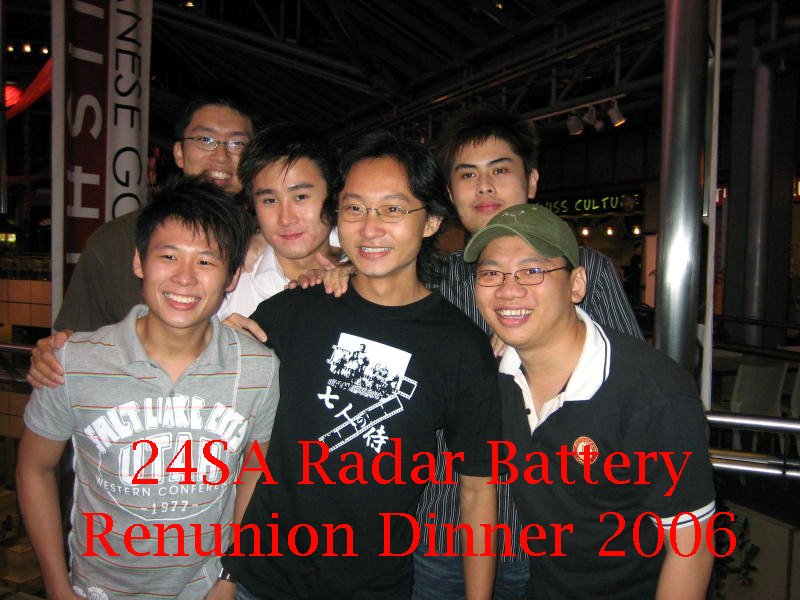
24SA Reunion gathering 2006

It was a faithful Saturday, I was at home sprinng cleaning my humble little room. My room was in a big mess with 3 to 4 big bag full of rubbish. I din know my room so full of rubbish for just a year since I last spring cleaning in jan 2005. After I about to spring cleaning finish my room, a call from my old buddy in national service asking me why i have not come to meet up as they are all waiting for me. Arghh.... I have actually got mix up with the date that i suppose to have a gathering ever since our ORD three years back.
So i hurriely complete my stuff and took a quick bath and rush down to meet them up. HAHA it like a long time I nv been rushing about to get to a place from home to suntec city. I just remenbered it back while serving my NS i was rushing about to get thing done or get thing to be done as soon as possible. HAHA.

The pioneer batch of 24SA Sergents from Radar Battery.
All 10 Sergents present.


The pioneer batch of 24SA Mens from Radar Battery.
Absent with reason about 4 more mens.


The pioneer batch of 24SA Sergents and mens from Radar Battery.

Thursday, January 05, 2006

What Busy Week!!

HEY TO ALL, WISH ALL OF YOU A HAPPY NEW YEAR AND HAVE A GREAT AND WONDERFULL YEAR AHEAD.
Well, today thursday and I am still working hard on my MST for tomorrow last paper. This still considered not that bad as things still the same except for preparing exam. Well this the usual life of a typical students of all singaporean. Right?
Anyway tml is my final paper, must jiayou then after that go join with my usual gang for dinner then go sentosa. Which is still the tentative plan for now. I'm praying hard tml if can drive out tml or nt, if nt no choice loh. Cus I presume tml there might be lot of ppl then our usual gang which consist of Yongsheng, Desmond, Terence n me.
Well, shall write up to here as for a fresh new beginning of 2006.
Hope this year will bring me luck n thing will goes on smoothly.

Saturday, December 31, 2005

My rate of life

This Is My Life, Rated
Life:
5.8
Mind:
5
Body:
5.7
Spirit:
6.3
Friends/Family:
5.1
Love:
2.1
Finance:
3.6
Take the Rate My Life Quiz


Analysis of Your Life Score Results

Your Life Analysis:

Life: Your life rating is a score of the sum total of your life, and accounts for how satisfied, successful, balanced, capable, valuable, and happy you are. The quiz attempts to put a number on the summation of all of these things, based on your answers. Your life score leaves room for improvement. You can make changes to improve your trouble areas, and this will bring you greater satisfaction. Focus on your weakest points and set about to change them. Do not delay your happiness and success. (Read more on improving your life)

Mind: Your mind rating is a score of your mind's clarity, ability, and health. Higher scores indicate an advancement in knowledge, clear and capable thinking, high mental health, and pure thought free of interference. Your mind score is not bad, but could be improved upon. Your mental health is not weak, but you are not achieving full mental clarity and function. Learn how to unclutter your mind. Keep learning, keep improving, continue moving forward. Read advice from other quiz-takers on improving the mind.

Body: Your body rating measures your body's health, fitness, and general wellness. A healthy body contributes to a happy life, however many of us are lacking in this area. Your body score is fairly average, which means there is room for improvement. Keep a focus on your physical health. Protect your body as it is your most valuable physical asset. Nutrition, stress reduction, and exercise are key. Read advice from other quiz-takers on improving the body.

Spirit: Your spirit rating seeks to capture in a number that elusive quality which is found in your faith, your attitude, and your philosophy on life. A higher score indicates a greater sense of inner peace and balance. Your spirit score leaves room for improvement. Consider making a concerted effort to redefine your attitudes and focus your beliefs. Boosting your spirit will lead to greater life satisfaction. Read advice from other quiz-takers on improving the spirit.

Friends/Family: Your friends and family rating measures your relationships with those around you, and is based on how large, healthy, and dependable your social network is. Your friends and family score is not bad but can be improved. Maintain your current social net, while you try to expand it. Try new things and form new friendships. You will be rewarded greatly.

Love: Your love rating is a measure of your current romantic situation. Sharing your heart with another person is one of life's most glorious, terrifying, rewarding experiences. Your love score is very low, indicating trouble. There is love out there for you. Seek the advice of wise people on how to go about finding it. Do not lose hope. Read advice from other quiz-takers on finding and maintaining love.

Finance: Your finance rating is a score that rates your current financial health and stability. Your financial score indicates some trouble. Raise your score over time by making changes which will lead to greater prosperity in the future. Be sure to live within your means today. Read advice from other quiz-takers on improving your finances.

Saturday, November 12, 2005

An Article by Ajaan Chah

While reading an article from Ajaan Chah, I find that it is really useful to know more indepth of buddhism. Here are some inspriation which i find it very meaningfull.

Fragments of a Teaching

All of you have believed in Buddhism for many years now through hearing about the Buddhist Teachings from many sources -- especially from various monks and teachers. In some cases Dhamma is taught in very broad and vague terms to the point where it is difficult to know how to put it into practice in daily life. In other instances Dhamma is taught in high language or special jargon to the point where most people find it difficult to understand, especially if the teaching is done too literally from scripture. Lastly there is Dhamma taught in a balanced way, neither too vague nor too profound, neither too broad nor too esoteric -- just right for the listener to understand and practice to personally benefit from the Teachings. Today I would like share with you Teachings of the sort I have often used to instruct my disciples in the past; Teachings which I hope may possibly be of personal benefit to those of you here listening today.


One who wishes to reach the Buddha-Dhamma

One who wishes to reach the Buddha-Dhamma must firstly be one who has faith or confidence as a foundation. He must understand the meaning of Buddha-Dhamma as follows:
Buddha: the One-Who-Knows, the one who has purity, radiance and peace in his heart.

Dhamma: the characteristics of purity, radiance and peace which arise from morality, concentration and wisdom.

Therefore, one who is to reach the Buddha-Dhamma is one who cultivates and develops morality, concentration and wisdom within himself.


Walking the Path of Buddha-Dhamma

Naturally people who wish to reach their home are not those who merely sit and think of traveling. They must actually undertake the process of traveling step by step, and in the right direction as well, in order to finally reach home. If they take the wrong path they may eventually run into difficulties such as swamps or other obstacles which are hard to get around. Or they may run into dangerous situations in this wrong direction, thereby possibly never reaching home.

Those who reach home can relax and sleep comfortably -- home is a place of comfort for body and mind. Now they have really reached home. But if the traveler only passed by the front of his home or only walked around it, he would not receive any benefit from having traveled all the way home.

In the same way, walking the path to reach the Buddha-Dhamma is something each one of us must do individually ourselves, for no one can do it for us. And we must travel along the proper path of morality, concentration and wisdom until we find the blessings of purity, radiance and peacefulness of mind that are the fruits of traveling the path. However, if one only has knowledge of books and scriptures, sermons and sutras, that is, only knowledge of the map or plans for the journey, even in hundreds of lives one will never know purity, radiance and peacefulness of mind. Instead one will just waste time and never get to the real benefits of practice. Teachers are those who only point out the direction of the Path. After listening to the teachers, whether or not we walk the Path by practicing ourselves, and thereby reap the fruits of practice, is strictly up to each one of us.

Another way to look at it is to compare practice to a bottle of medicine a doctor leaves for his patient. On the bottle is written detailed instructions on how to take the medicine, but no matter how many hundred times the patient reads the directions, he is bound to die if that is all he does. He will gain no benefit from the medicine. And before he dies he may complain bitterly that the doctor wasn't any good, that the medicine didn't cure him! He will think that the doctor was a fake or that the medicine was worthless, yet he has only spent his time examining the bottle and reading the instructions. He hasn't followed the advice of the doctor and taken the medicine.

However, if the patient actually follows the doctor's advice and takes the medicine regularly as prescribed, he will recover. And if he is very ill, it will be necessary to take a lot of medicine, whereas if he is only mildly ill, only a little medicine will be needed to finally cure him. The fact that we must use a lot of medicine is a result of the severity of our illness. It's only natural and you can see it for yourself with careful consideration.

Doctors prescribe medicine to eliminate disease from the body. The Teachings of the Buddha are prescribed to cure disease of the mind, to bring it back to its natural healthy state. So the Buddha can be considered to be a doctor who prescribes cures for the ills of the mind. He is, in fact, the greatest doctor in the world.

Mental ills are found in each one of us without exception. When you see these mental ills, does it not make sense to look to the Dhamma as support, as medicine to cure your ills? Traveling the path of the Buddha-Dhamma is not done with the body. You must travel with the mind to reach the benefits. We can divide these travelers into three groups:

First Level: this is comprised of those who understand that they must practice themselves, and know how to do so. They take the Buddha, Dhamma and Sangha as their refuge and have resolved to practice diligently according to the Teachings. These persons have discarded merely following customs and traditions, and instead use reason to examine for themselves the nature of the world. These are the group of "Buddhist believers."

Middle Level: This group is comprised of those who have practiced until they have an unshakable faith in the Teachings of the Buddha, the Dhamma and the Sangha. They also have penetrated to the understanding of the true nature of all compounded formations. These persons gradually reduce clinging and attachment. They do not hold onto things and their minds reach deep understanding of the Dhamma. Depending upon the degree of non-attachment and wisdom they are progressively known as stream-enterers, once-returners and nonreturners, or simply, Noble Ones.

Highest Level: This is the group of those whose practice has led them to the body, speech and mind of the Buddha. They are above the world, free of the world, and free of all attachment and clinging. They are known as Arahats or Free Ones, the highest level of the Noble Ones.


How to Purify One's Morality

Morality is restraint and discipline of body and speech. On the formal level this is divided into classes of precepts for lay people and for monks and nuns. However, to speak in general terms, there is one basic characteristic -- that is INTENTION. When we are mindful or self-recollected, we have right intention. Practicing self-recollection and mindfulness will generate good morality.

It is only natural that when we put on dirty clothes and our bodies are dirty, that out minds too will feel uncomfortable and depressed. However, if we keep our bodies clean and wear clean, neat clothes, it makes our minds light and cheerful. So too, when morality is not kept, our bodily actions and speech are dirty, and this is a cause for making the mind unhappy, distressed and heavy. We are separated from right practice and this prevents us from penetrating in the essence of the Dhamma in our minds. The wholesome bodily actions and speech themselves depend on mind, properly trained, since mind orders body and speech. Therefore, we must continue practice by training our minds.


Practice of Concentration Training

The training in concentration is practiced to make the mind firm and steady. This brings about peacefulness of mind. Usually our untrained minds are moving and restless, hard to control and manage. Mind follows sense distractions wildly just like water flowing this way and that, seeking the lowest level. Agriculturists and engineers, though, know how to control water so that it is of greater use to mankind. Men are clever, they know how to dam water, make large reservoirs and canals -- all of this merely to channel water and make it more useable. In addition the water stored becomes a source of electrical power and light, further benefits from controlling its flow so that it doesn't run wild and eventually settle into a few low spots, its usefulness wasted.

So too, the mind which is dammed and controlled, trained constantly, will be of immeasurable benefit. The Buddha Himself taught, "The mind that has been controlled brings true happiness, so train you minds well for the highest of benefits." Similarly, the animals we see around us -- elephants, horses, cattle, buffalo, etc., must be trained before they can be useful for work. Only after they have been trained is their strength of benefit to us.

In the same way, the mind that has been trained will bring many times the blessings of that of an untrained mind. The Buddha and His Noble Disciples all started out in the same way as us -- with untrained minds; but afterwards look how they became the subjects of reverence for us all, and see how much benefit we can gain through their teaching. Indeed, see what benefit has come to the entire world from these men who have gone through the training of the mind to reach the freedom beyond. The mind controlled and trained is better equipped to help us in all professions, in all situations. The disciplined mind will keep our lives balanced, make work easier and develop and nurture reason to govern our actions. In the end our happiness will increase accordingly as we follow the proper mind training.

The training of the mind can be done in many way, with many different methods. The method which is most useful and which can be practiced by all types of people is known as "mindfulness of breathing." It is the developing of mindfulness on the in-breath and the out-breath. In this monastery we concentrate our attention on the tip of the nose and develop awareness of the in- and out-breaths with the mantra word "BUD-DHO." If the meditator wishes to use another word, or simply be mindful of the air moving in and out, this is also fine. Adjust the practice to suit yourself. The essential factor in the meditation is that the noting or awareness of the breath be kept up in the present moment so that one is mindful of each in-breath and each out-breath just as it occurs. While doing walking meditation we try to be constantly mindful of the sensation of the feet touching the ground.

This practice of meditation must be pursued as continuously as possible in order for it to bear fruit. Don't meditate for a short time one day and then in one or two weeks, or even a month, meditate again. This will not bring results. The Buddha taught us to practice often, to practice diligently, that is, to be as continuous as we can in the practice of mental training. To practice meditation we should also find a suitably quiet place free from distractions. In gardens or under shady trees in our back yards, or in places where we can be alone are suitable environments. If we are a monk or nun we should find a suitable hut, a quiet forest or cave. The mountains offer exceptionally suitable places for practice.

In any case, wherever we are, we must make an effort to be continuously mindful of breathing in and breathing out. If the attention wanders to other things, try to pull it back to the object of concentration. Try to put away all other thoughts and cares. Don't think about anything -- just watch the breath. If we are mindful of thoughts as soon as they arise and keep diligently returning to the meditation subject, the mind will become quieter and quieter. When the mind is peaceful and concentrated, release it from the breath as the object of concentration. Now begin to examine the body and mind comprised of the five khandas: material form, feelings, perceptions, mental formations and consciousness. Examine these five khandas as they come and go. You will see clearly that they are impermanent, that this impermanence makes them unsatisfactory and undesirable, and that they come and go of their own -- there is no "self" running things. There is to be found only nature moving according to cause and effect. All things in the world fall under the characteristics of instability, unsatisfactoriness and being without a permanent ego or soul. Seeing the whole of existence in this light, attachment and clinging to the khandas will gradually be reduced. This is because we see the true characteristics of the world. We call this the arising of wisdom.

The Arising of Wisdom

Wisdom is to see the truth of the various manifestations of body and mind. When we use our trained and concentrated minds to examine the five khandas, we will see clearly that both body and mind are impermanent, unsatisfactory and soul-less. In seeing all compounded things with wisdom we do not cling or grasp. Whatever we receive, we receive mindfully. We are not excessively happy. When things of ours break up or disappear, we are not unhappy and do not suffer painful feelings -- for we see clearly the impermanent nature of all things. When we encounter illness and pain of any sort, we have equanimity because our minds have been well trained. The true refuge is the trained mind.

All of this is known as wisdom which knows the true characteristics of things as they arise. Wisdom arises from mindfulness and concentration. Concentration arises from a base of morality or virtue. All of these things, morality, concentration and wisdom, are so inter-related that it is not really possible to separate them. In practice it can be looked at in this way: first there is the disciplining of the mind to be attentive to breathing. This is the arising of morality. When mindfulness of breathing is practiced continuously until the mind is quiet, this is the arising of concentration. Then examination showing the breath as impermanent, unsatisfactory and not-self, and the subsequent non-attachment, is the arising of wisdom. Thus the practice of mindfulness of breathing can be said to be a course for the development of morality, concentration and wisdom. They all come together.

When morality, concentration and wisdom are all developed, we call this practicing the Eightfold Path which the Buddha taught as our only way out of suffering. The Eightfold Path is above all others because if properly practiced it leads directly to Nibbana, to peace. We can say that this practice reaches the Buddha-Dhamma truly and precisely.

Benefits from Practice

When we have practiced meditation as explained above, the fruits of practice will arise in the following three stages:

First, for those practitioners who are at the level of "Buddhist be faith," there will arise increasing faith in the Buddha, Dhamma and Sangha. This faith will become the real inner support of each person. Also, they will understand the cause-and-effect nature of all things, that wholesome action brings wholesome result and that unwholesome action brings unwholesome result. So for such a person there will be a great increase in happiness and mental peace.

Second, those who have reached the noble attainments of stream-winner, once-returner or nonreturner, have unshakable faith in the Buddha, Dhamma and Sangha. They are joyful and are pulled towards Nibbana.

Third, for those Arahats or Perfected Ones, there will be the happiness free from all suffering. These are the Buddhas, free from the world, complete in the Faring of the Holy Way.

We all have had the good fortune to be born as human beings and to hear the Teachings of the Buddha. This is an opportunity that millions of other beings do not have. Therefore do not be careless or heedless. Hurry and develop merits, do good and follow the path of practice in the beginning, in the middle and in the highest levels. Don't let time roll by unused and without purpose. Try to reach the truth of the Buddha's Teachings even today. Let me close with a Lao folk-saying: "Many rounds of merriment and pleasure past, soon it will be evening. Drunk with tears now, rest and see, soon it will be too late to finish the journey."

A Gift of Dhamma

(A Discourse delivered to the assembly of Western Monks, Novices and Lay-disciples at Bung Wai Forest Monastery, Ubon, on 10th October, 1977. This Discourse was offered to the parents of one of the monks on the occasion of their visit from France.)

I am happy that you have taken this opportunity to come and visit Wat Pah Pong, and to see your son who is a monk here, however I'm sorry I have no gift to offer you. France already has so many material things, but of Dhamma there's very little. Having been there and seen for myself, there isn't really any Dhamma there which could lead to peace and tranquillity. There are only things which continually make one's mind confused and troubled.

France is already materially prosperous, it has so many things to offer which are sensually enticing -- sights, sounds, smells, tastes and textures. However, people ignorant of Dhamma only become confused by them. So today I will offer you some Dhamma to take back to France as a gift from Wat Pah Pong and Wat Pah Nanachat.

What is Dhamma? Dhamma is that which can cut through the problems and difficulties of mankind, gradually reducing them to nothing. That's what is called Dhamma and that's what should be studied throughout our daily lives so that when some mental impression arises in us, we'll be able to deal with it and go beyond it.

Problems are common to us all whether living here in Thailand or in other countries. If we don't know how to solve them, we'll always be subject to suffering and distress. That which solves problems is wisdom and to have wisdom we must develop and train the mind.

The subject of practice isn't far away at all, it's right here in our body and mind. Westerners and Thais are the same, they both have a body and mind. A confused body and mind means a confused person and a peaceful body and mind, a peaceful person.

Actually, the mind, like rain water, is pure in its natural state. If we were to drop green coloring into clear rain water, however, it would turn green. If yellow coloring it would turn yellow.

The mind reacts similarly. When a comfortable mental impression "drops" into the mind, the mind is comfortable. When the mental impression is uncomfortable, the mind is uncomfortable. The mind becomes "cloudy" just like the colored water.

When clear water contacts yellow, it turns yellow. When it contacts green, it turns green. It will change color every time. Actually, that water which is green or yellow is naturally clean and clear. This is also the natural state of the mind, clean and pure and unconfused. It becomes confused only because it pursues mental impressions; it gets lost in its moods!

Let me explain more clearly. Right now we are sitting in a peaceful forest. Here, if there's no wind, a leaf remains still. When a wind blows it flaps and flutters. The mind is similar to that leaf. When it contacts a mental impression, it, too, "flaps and flutters" according to the nature of that mental impression. And the less we know of Dhamma, the more the mind will continually pursue mental impressions. Feeling happy, it succumbs to happiness. Feeling suffering, it succumbs to suffering. It's constant confusion!

In the end people become neurotic. Why? Because they don't know! They just follow their moods and don't know how to look after their own minds. When the mind has no one to look after it, it's like a child without a mother or father to take care of him. An orphan has no refuge and, without a refuge, he's very insecure.

Likewise, if the mind is not looked after, if there is no training or maturation of character with right understanding, it's really troublesome.

The method of training the mind which I will give you today is Kammatthana. "Kamma" means "action" and "thana" means "base." In Buddhism it is the method of making the mind peaceful and tranquil. It's for you to use in training the mind and with the trained mind investigate the body.

Our being is composed of two parts: one is the body, the other, the mind. There are only these two parts. What is called "the body," is that which can be seen with our physical eyes. "The mind," on the other hand, has no physical aspect. The mind can only be seen with the "internal eye" or the "eye of the mind." These two things, body and mind, are in a constant state of turmoil.

What is the mind? The mind isn't really any "thing." Conventionally speaking, it's that which feels or senses. That which senses, receives and experiences all mental impressions is called "mind." Right at this moment there is mind. As I am speaking to you, the mind acknowledges what I am saying. Sounds enter through the ear and you know what is being said. That which experiences this is called "mind."

This mind doesn't have any self or substance. It doesn't have any form. It just experiences mental activities, that's all! If we teach this mind to have right view, this mind won't have any problems. It will be at ease.

The mind is mind. Mental objects are mental objects. Mental objects are not the mind, the mind is not mental objects. In order to clearly understand our minds and the mental objects in our minds, we say that the mind is that which receives the mental objects which pop into it.

When these two things, mind and its object, come into contact with each other, they give rise to feelings. Some are good, some bad, some cold, some hot, all kinds! Without wisdom to deal with these feelings, however, the mind will be troubled.

Meditation is the way of developing the mind so that it may be a base for the arising of wisdom. Here the breath is a physical foundation. We call it Anapanasati or "mindfulness of breathing." Here we make breathing our mental object. We take this object of meditation because it's the simplest and because it has been the heart of meditation since ancient times.

When a good occasion arises to do sitting meditation, sit cross-legged: right leg on top of the left leg, right hand on top of the left hand. Keep your back straight and erect. Say to yourself, "Now I will let go of all my burdens and concerns." You don't want anything that will cause you worry. Let go of all concerns for the time being.

Now fix your attention on the breath. Then breathe in and breathe out. In developing awareness of breathing, don't intentionally make the breath long or short. Neither make it strong or weak. Just let it flow normally and naturally. Mindfulness and self-awareness, arising from the mind, will know the in-breath and the out-breath.

Be at ease. Don't think about anything. No need to think of this or that. The only thing you have to do is fix your attention on the breathing in and breathing out. You have nothing else to do but that! Keep your mindfulness fixed on the in-and out-breaths as they occur. Be aware of the beginning, middle and end of each breath. On inhalation, the beginning of the breath is at the nose tip, the middle at the heart, and the end in the abdomen. On exhalation, it's just the reverse: the beginning of the breath is in the abdomen, the middle at the heart, and the end at the nose tip. Develop the awareness of the breath: 1, at the nose tip; 2, at the heart; 3, in the abdomen. Then in reverse: 1, in the abdomen; 2, at the heart; and 3, at the nose tip.

Focusing the attention on these three points will relieve all worries. Just don't think of anything else! Keep your attention on the breath. Perhaps other thoughts will enter the mind. It will take up other themes and distract you. Don't be concerned. Just take up the breathing again as your object of attention. The mind may get caught up in judging and investigating your moods, but continue to practice, being constantly aware of the beginning, middle and the end of each breath.

Eventually, the mind will be aware of the breath at these three points all the time. When you do this practice for some time, the mind and body will get accustomed to the work. Fatigue will disappear. The body will feel lighter and the breath will become more and more refined. Mindfulness and self-awareness will protect the mind and watch over it.

We practice like this until the mind is peaceful and calm, until it is one. One means that the mind will be completely absorbed in the breathing, that it doesn't separate from the breath. The mind will be unconfused and at ease. It will know the beginning, middle and end of the breath and remain steadily fixed on it.

Then when the mind is peaceful, we fix our attention on the in-breath and out-breath at the nose tip only. We don't have to follow it up and down to the abdomen and back. Just concentrate on the tip of the nose where the breath comes in and goes out.

This is called "calming the mind," making it relaxed and peaceful. When tranquillity arises, the mind stops; it stops with its single object, the breath. This is what's known as making the mind peaceful so that wisdom may arise.

This is the beginning, the foundation of our practice. You should try to practice this every single day, wherever you may be. Whether at home, in a car, lying or sitting down, you should be mindfully aware and watch over the mind constantly.

This is called mental training which should be practiced in all the four postures. Not just sitting, but standing, walking and lying as well. The point is that we should know what the state of the mind is at each moment, and, to be able to do this, we must be constantly mindful and aware. Is the mind happy or suffering? Is it confused? Is it peaceful? Getting to know the mind in this manner allows it to become tranquil, and when it does become tranquil, wisdom will arise.

With the tranquil mind investigate the meditation subject which is the body, from the top of the head to the soles of the feet, then back to the head. Do this over and over again. Look at and see the hair of the head, hair of the body, the nails, teeth and skin. In this meditation we will see that this whole body is composed of four "elements': earth, water, fire and wind.

The hard and solid parts of our body make up the earth element; the liquid and flowing parts, the water element. Winds that pass up and down our body make up the wind element, and the heat in our body, the fire element.

Taken together, they compose what we call a "human being." However, when the body is broken down into its component parts, only these four elements remain. The Buddha taught that there is no "being" per se, no human, no Thai, no Westerner, no person, but that ultimately, there are only these four elements -- that's all! We assume that there is a person or a "being" but, in reality, there isn't anything of the sort.

Whether taken separately as earth, water, fire and wind, or taken together labelling what they form a "human being," they're all impermanent, subject to suffering and not-self. They are all unstable, uncertain and in a state of constant change -- not stable for a single moment!

Our body is unstable, altering and changing constantly. Hair changes, nails change, teeth change, skin changes -- everything changes, completely!

Our mind, too, is always changing. It isn't a self or substance. It isn't really "us," not really "them," although it may think so. Maybe it will think about killing itself. Maybe it will think of happiness or of suffering -- all sorts of things! It's unstable. If we don't have wisdom and we believe this mind of ours, it'll lie to us continually. And we alternately suffer and be happy.

This mind is an uncertain thing. This body is uncertain. Together they are impermanent. Together they are a source of suffering. Together they are devoid of self. These, the Buddha pointed out, are neither a being, nor a person, nor a self, nor a soul, nor us, nor they. They are merely elements: earth, water, fire and wind. Elements only!

When the mind sees this, it will rid itself of attachment which holds that "I" am beautiful, "I" am good, "I" am evil, "I" am suffering, "I" have, "I" this or "I" that. You will experience a state of unity, for you'll have seen that all of mankind is basically the same. There is no "I." There are only elements.

When you contemplate and see impermanence, suffering and not-self, there will no longer be clinging to a self, a being, I or he or she. The mind which sees this will give rise to Nibbida, world-weariness and dispassion. It will see all things as only impermanent, suffering and not-self.

The mind then stops. The mind is Dhamma. Greed, hatred and delusion will then diminish and recede little by little until finally there is only mind -- just the pure mind. This is called "practicing meditation."

Thus, I ask you to receive this gift of Dhamma which I offer you to study and contemplate in your daily lives. Please accept this Dhamma Teaching from Wat Pah Pong and Wat Pah Nanachat as an inheritance handed down to you. All of the monks here, including your son, and all the Teachers, make you an offering of this Dhamma to take back to France with you. It will show you the way to peace of mind, it will render your mind calm and unconfused. Your body may be in turmoil, but your mind will not. Those in the world may be confused, but you will not. Even though there is confusion in your country, you will not be confused because the mind will have seen, the mind is Dhamma. This is the right path, the proper way.

May you remember this Teaching in the future.

May you be well and happy.

Why: People have a reason for their behaviour

while reading an email, I came across this article that is really intresting and dharma inspriation.

Why?People have a reason for their behaviour

Why do people do what they do? Because they have reasons, that's why. But when their reasons are misunderstood or not understood, problems can arise. And often the problems are serious. Relationships may be torn apart, family members may squabble, violence may break out, and countries may go to war - all because of misunderstandings. But why are the intentions of others so difficult to decipher?

To answer this question, all we have to do is examine our own actions. Then, we will discover, as Aristotle (384 ~ 322 BC) has said, "All that we do is done with an eye to something else." That is, we often hide our true motives. For example, Betty visits Aunt Emma, not because there's nothing else she would rather do, but because she feels obligated. Francis may go to work 30 minutes early every day, not because he wants to, but because his manager does, and he feels pressured to do the same. If we wish to avoid misunderstandings, we need to stop looking AT the actions of others and start looking FOR the reasons behind their behaviour. Let's look at an example in greater detail.

Whenever Joanne speaks with her friend Lorraine, she always manages to slip a sentence into the conversation that goes like this, "Lorraine, you need to lose weight!" Why does Joanne do that? What's her motive? If you could read Joanne's heart, you would realize she is not saying, "Lorraine, you are fat!" What she is really saying is, "Lorraine, look at me; I'm so slim and beautiful!" Joanne wasn't trying to encourage Lorraine to lose weight, but was hoping Lorraine would compliment her for being so slim. You see, Joanne suffers from low self-esteem and is desperately seeking the approval of others. She is starving for recognition, approval, and love.

If we were to judge Joanne's words by their appearance, we could mistakenly assume that she is deliberately hurtful. Such a conclusion may cause us to grow angry, defensive, and vindictive. And those feelings may spur us to act rashly and end a relationship. Yet, if we were to see beyond the words, if we were to comprehend with our hearts instead of our minds, our feelings and conduct would be completely different. For once we realized that she wasn't really insulting us but crying out for help and pleading for approval, we would feel pity, not anger, and we would become compassionate, not vindictive. This change of view makes a big difference, doesn't it? For when we are compassionate, we contribute to the world, but when we take offense, we add more tension to the world. So, when people say cruel things, don't be hurt, be reasonable. Don't look AT their actions, but FOR their motives.

How do we probe into the root causes and find the reasons behind the conduct of others? One thing we can do is borrow a very useful tool from Japanese business management practices. When faced with a problem, rather than asking WHY once, they ask at least five times. Each time they ask WHY, they arrive at a deeper understanding and closer to the solution. Let's look at an example.

Nineteen-year-old Joey stabbed a man and stole his money. WHY did he do so? The answer in many quarters of the United States would be, "Because he is evil. He is a wicked person." What is the solution? "Lock him up! Put him in prison!" The first WHY we ask merely scratches the surface and offers superficial solutions.

Let's move on to the second WHY: "Why is Joey 'evil'? Why does he lack a conscience?" After probing deeper, we learn that Joey, unlike most children, did not receive any guidance while growing up. Now we come to WHY #3: "Why didn't Joey get any guidance as a child?" The answer is, we learn, because his father was an alcoholic and his mother was more concerned with her needs than those of her son.

Perhaps Joey didn't get any guidance at home, but why (WHY #4) wasn't he helped at school? Because a damaged (cracked) cup doesn't hold water. That is, constantly scolded by his parents, Joey believed he was incapable of learning at school. And failure to receive help from adults led to a build up of rage. "If no one cares about me," he thought, "I don't care about anyone."

But WHY (#5) didn't schools provide satisfactory counseling and set Joey straight? How could they with overcrowded classrooms, burned-out or unfit teachers, and government cuts that are draining schools of necessary resources?

When faced with the problem of Joey, what happens when we stop with WHY #1 and lock him up? Well, Joey loses his freedom, the world loses his potential contribution, his friends and family lose his company, and as soon as he is taken off the streets, he is replaced by another Joey. The 'solution,' it turns out, is not a solution, but a process that perpetuates the problem. Yet, if we were to dig deeper, and correct root causes like poverty, child abuse, and inadequate education, we could stop the endless parade of Joeys marching into prison. Yes, if were to take the time and make the effort to be thoughtful, we could make the world a safer and happier place.

We cannot make others greater by diminishing them and telling them they are criminals. Shall we lock up the blind because they refuse to see, the deaf because they won't listen, and the mute who won't answer? Why is it we don't hesitate to lock up the deprived? Of course, society needs protection, but let's not forget 'criminals' need HELP. Those who help the least among us become the greatest among us. By empowering others, they strengthen society.

It is not only criminals that need help. Almost everyone is in need. Stop for a moment and think of the pain you feel when someone criticizes you. Criticism can ruin your day, your week, or even your life. Now reverse this equation and try to imagine the power of a kind word or gentle touch. No wonder Dr. Leo(nardo) Felice Buscaglia (1924 ~ 1998) said, "Too often we underestimate the power of a touch, a smile, a kind word, a listening ear, an honest compliment, or the smallest act of caring, all of which have the potential to turn a life around."

Yes, understanding the reasons behind the apparent rude behaviour of others can make us more compassionate. But that is just the beginning, for as we grow more spiritually aware we come to realize that all reasons, motives, and intentions are the same. Each person in their own way is seeking happiness. So, how can we find fault with them? If they occasionally stumble and step on our toes, can't we forgive them? At the highest spiritual level, we no longer look for or think about the motives of others. Instead, we accept them, love them, and see them for what they are in all their splendor. Let's accept the individuality of all and allow others to lead their lives as exclamations, not explanations.